
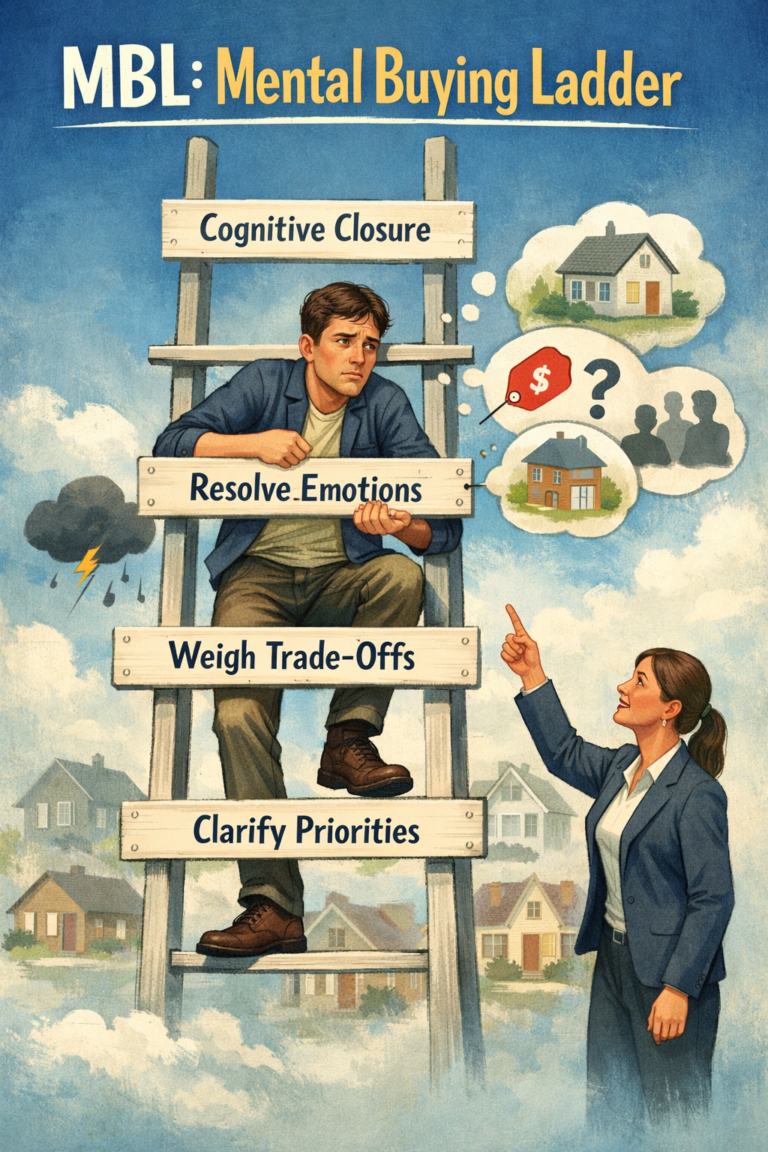
“Argh!… my buyers can’t decide!”
“They keep changing their mind.”
“They seem to love my product, but they won’t commit!”
Sounds familiar, right?
But from a psychological standpoint, that diagnosis is wrong.
Most buyers aren’t indecisive.
They’re unprocessed.
Let me explain…
Decision-Making Isn’t One Moment. It’s a Sequence.
People don’t make big financial decisions in one giant step. Instead, they move through a predictable mental progression that I call the “MBL: Mental Buying Ladder.” And every rung on this ladder gives your buyer the comfort to move up the next rung in the sequence…
RUNG #1: They Clarify their internal priorities
Your buyer identifies what actually matters to them versus what merely sounds good in theory.
RUNG #2: They weigh the trade-offs
Your buyer accepts that getting one benefit means giving up another and decides which losses are tolerable.
RUNG #3: They resolve emotional conflicts
Your buyer quiets fear, doubt, and outside influence so emotion no longer interferes with the decision.
RUNG #4: They reaching cognitive closure
Lastly, your buyer mentally locks in the choice and stops re-evaluating alternatives.
Not quite a single-step process, is it?
When this sequence is incomplete, the brain resists commitment… no matter how good the product you’re showing them looks.
Salespeople often mistake this resistance for “shopping around” or “keeping their options open.” In reality, your buyer’s decision system is overloaded or unresolved.
FACT: More Options Do Not Create More Certainty
One of the most misunderstood aspects of buyer psychology is this:
Showing more options does not help your undecided buyers decide.
Actually, it often does the opposite.
As their options increase, their brain shifts from evaluation mode to avoidance mode. Buyers become anxious, comparison-focused, and less confident in every choice.
This is why some buyers appear enthusiastic during a sales pitch… yet stall when it’s time to act.
HINT: They are not stalling. They are protecting themselves from making a “wrong” decision.
What You’re Missing About Buyer Drift
From a sales manager’s perspective, this creates three silent problems:
1) Salespeople invest time without commitment
2) Buyers quietly disengage or switch to different sellers
3) The whole deal collapses at the very end
None of this is random.
When buyers aren’t mentally organized early, they remain vulnerable to outside influence later… friends, family, other sellers who appear at the right psychological moment.
Truth is… loyalty doesn’t disappear. It never fully forms.
The High-Value Shift
Top-performing salespeople do something differently… not tactically, but psychologically.
They focus less on product choices and more on decision readiness.
They recognize when a buyer:
• Has unresolved trade-offs
• Is avoiding internal conflict
• Is overwhelmed by choice
• Is not yet capable of committing
And instead of pushing forward, they slow the process down strategically… helping the buyer resolve internal friction before adding more information.
The result?
• Fewer wasted hours
• Stronger buyer confidence
• Faster, cleaner decisions
The Key Takeaway
Buyers don’t need more options. They need clearer internal alignment.
Salespeople who understand how decisions actually form stop chasing behavior… and start guiding outcomes.
That’s the difference between being busy and being effective.