
There’s a simple way to tell whether an advertisement is doing its job.
Listen to what people say after they see it.
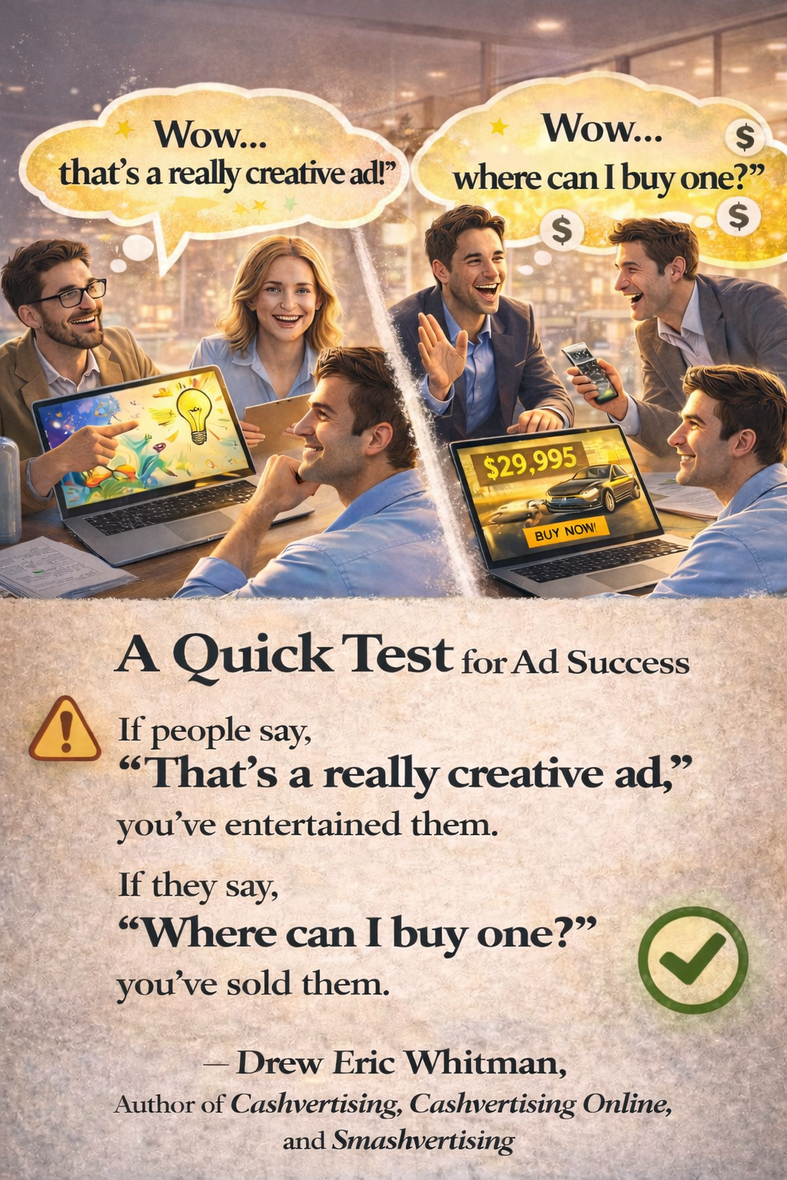
If they say, “Wow… that’s a really creative ad,” you’ve entertained them.
If they say, “Where can I buy one?” you’ve sold them.
Obvious, right? Yet thousands of advertisers get it backwards every day.
The Creativity Trap
Creativity in advertising has become a kind of idol. Agencies chase clever concepts, witty headlines, cinematic visuals, and elaborate storytelling. They’re more interested in winning awards. Or at least, they think that if it’s creative it will also SELL.
But entertainment isn’t the same thing as persuasion.
An ad can be beautifully designed, brilliantly written, and look beautiful… and still fail completely at its one real job: causing people to click the BUY button or dig their hands into their pocket to pull out cash.
This is the trap!
You DON’T want people to talk about your AD. You want them to talk about the thing your ad talks about!
For instance… imagine you’ve just finished eating dinner at a fine local restaurant.
The waiter asks, “Would you like see our desserts?”
“SURE!” you say.
So the waiter brings back a gorgeous, sparkling, gold-plated serving tray adorned with sparkly lights and glitter… the vehicle upon which he will eventually carry out your dessert.
How enticed will you be for the deserts he describes when all the attention is solely on the tray itself?
Silly, I know, but I think you get my point: Your attention will be on the wrong thing!
What Successful Ads Actually Do
Successful ads perform a specific task.
They cause your prospect to demonstrate your product IN THEIR HEADS before they actually own it.
They imagine…
Driving the car.
Using the tool.
Eating the dessert.
Wearing the watch.
Experiencing the benefit.
At that moment, the advertisement has shifted the viewer’s attention away from the ad… and toward the product.
Aha! You’ve done your job. You’ve brought attention to the thing you want to sell… not the tool… the vehicle… that you’re using to sell it.
And when that happens, your buyer is no longer evaluating your ad…
… they’re imagining possession! (And the sale is half closed.)
That’s because once someone begins mentally experiencing ownership, the natural next question appears almost automatically:
“Where can I buy one?”
The Difference Between Entertaining and Selling
This difference is subtle but critical.
Entertaining advertising attracts attention.
Persuasive advertising directs attention.
Entertaining advertising makes the audience appreciate the ad.
Persuasive advertising makes the audience want the product.
Entertaining advertising earns applause.
Persuasive advertising earns orders.
A Simple Test You Can Apply
Whenever you review an advertisement—your own or someone else’s—ask one question:
What response does this ad create?
Does it make people say:
“That’s a clever ad.”
Or does it make them ask:
“Where can I buy this?”
The first reaction means the ad entertained.
The second reaction means the ad persuaded.
And persuasion—not entertainment—is what advertising is supposed to do.